
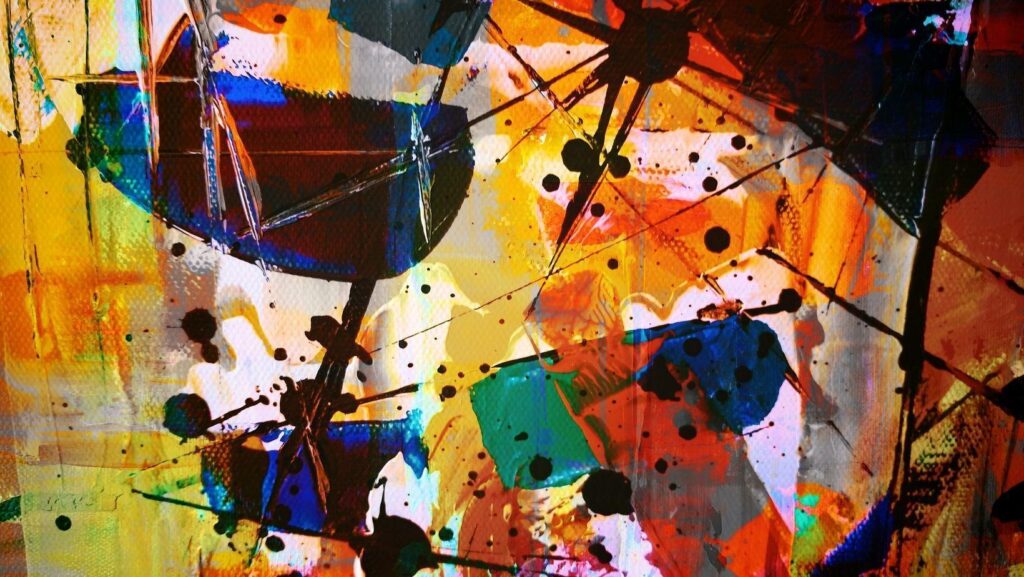
We’ve all seen it happen. You’re walking through a modern art museum, and you come across a crowd gathered in front of a massive canvas. Maybe it’s just a solid block of blue, a chaotic web of paint drips, or a couple of simple black lines on raw canvas. People stare in silence for a minute, trying to look deep. Then, inevitably, someone rolls their eyes and mutters the classic line: “My kid could do that.”
It’s easy to laugh at the cynicism, but that reaction actually points to something really interesting.
Why is abstract art so incredibly hard to explain or defend without sounding like a dry academic textbook, while actually making it feels so completely natural?
The truth is, we don’t struggle with abstraction because we don’t “get” art. We struggle because we are trying to use rigid, logical words to explain something that is essentially an emotional, non-verbal language. It’s like trying to describe a mood with a math equation—it just doesn’t fit.
If you want to get past that feeling of “not being smart enough” for modern art, you don’t need to read heavy theory or memorize museum pamphlets. You just need to get some paint on your hands. The moment you stop just looking and actually start doing, the whole “mystique” of abstract art disappears. You quickly realize that abstract painting isn’t a high-brow puzzle to solve—it’s just a playground where you get to make the rules.
- The Intellectual Trap: Why We Try to “Explain” Art
For centuries, Western art had a built-in safety net: representation. When you looked at a painting, you instantly knew what you were looking at. A landscape was a valley, a portrait was a nobleman, and a still life was a bowl of fruit. Even if the brushwork was wild, you had a narrative anchor. You could judge the artist’s skill by how successfully they mimicked real life.
But in the early 20th century, High Modernism tore that safety net to shreds. Pioneers like Wassily Kandinsky, Piet Mondrian, and Mark Rothko argued that art shouldn’t just copy the physical world. Instead, they wanted art to function like music—an arrangement of tones, rhythms, and harmonies that hits you straight in the chest without needing to show you a picture of a physical instrument.
Unfortunately, as the art itself became more abstract, the industry around it became incredibly wordy. Art critics, desperate to prove this new movement was serious, began wrapping abstraction in dense, gatekeeping jargon. They wrote essays about “flatness,” “spatial tension,” and “medium specificity” that left everyday gallery-goers feeling like they needed a PhD just to enjoy a painting.
This over-intellectualization created a massive language barrier. Abstraction bypasses the logical, analytical left side of our brain and speaks directly to the subconscious. Trying to explain a Rothko color field painting using academic prose is like trying to describe a grand symphony using only mathematical formulas. You can analyze the structure all day, but you are completely missing the point of how it actually feels.
- Why Abstraction is Surprisingly Natural to Create
While explaining a finished abstract piece can feel like an intellectual trap, starting one from scratch is incredibly liberating. The second you remove the pressure of making things look “real,” your relationship with the canvas changes.
When you aren’t stressing over whether a hand looks anatomically correct or if the perspective on a building is mathematically perfect, the fear of making a mistake disappears. You are freed from the tyranny of realism. This freedom unlocks a visual vocabulary that every single human possesses, whether they consider themselves “creative” or not.
Our brains are naturally wired for visual harmony, balance, and tension. You don’t need a design degree to know when a room is too cluttered, when a picture frame is crooked, or when a color combination feels satisfying. On a canvas, those exact same instincts take over:
- Weight and Balance: You intuitively feel when a large, dark shape on one side of a canvas creates a heavy visual “weight” that needs to be balanced by a splash of bright color or a delicate line on the other side.
- Tension and Contrast: You feel the energy when a sharp, aggressive diagonal line slices through a soft, dreamy color gradient. Your eyes naturally react to the spark of a warm, fiery orange sitting right next to a cool, deep blue.
- The Pure Joy of Painting: There is a deeply satisfying, almost meditative pleasure in the physical act of painting. Feeling the pull of the brush against the canvas, watching two wet colors bleed into a brand-new shade, and seeing thick textures catch the light are sensory experiences we’ve enjoyed since humans first painted on cave walls.
In this sense, abstraction is actually the most natural way to paint. It is a direct, gestural translation of your inner energy and mood, bypassing the need for literal translation.
- How “Paint by Numbers” Demystifies Modernism
If painting abstractly is so intuitive, why do so many of us freeze at the thought of trying it? It usually comes down to the sheer terror of the blank canvas.
For a beginner, absolute freedom can be paralyzing. When there are no rules, no boundaries, and infinite choices, “choice paralysis” kicks in. You start asking yourself: Where do I put the first stroke? Which shade of blue is the “right” one? How do I stop all these colors from mixing into a muddy, brown disaster?
This is where paint by numbers comes in. If you’ve never tried it, the concept is straightforward: you get a canvas pre-printed with light outlines of shapes, with each section marked with a number that corresponds to a specific pot of paint. Your only job is to match the numbers and fill in the spaces.
While most people associate these kits with traditional, realistic scenes like cozy cottages or puppies, the exact same method works brilliantly for abstract art. Instead of copying a physical object, the canvas is mapped out into bold geometric shapes, sweeping color blocks, and fluid, non-representational forms. It acts as a stress-free translator, taking a complex, balanced abstract design and breaking it down into a clean, numbered grid of color and form.
- Beyond the Gimmick: A Masterclass in Composition
Historically, stuffy art critics dismissed paint by numbers as a mechanical gimmick. But when applied to abstract art, it actually becomes a powerful, hands-on lesson in modern design.
By filling in the sections one by one, you get a tactile, step-by-step masterclass in composition. You physically witness how a modern painting is built from the ground up, watching the template transform into a textured, hand-painted piece.
Through this process, you realize that what looked like a random splash of paint in a museum is actually a highly calculated, deliberate dance of neighboring tones and structural boundaries. You see firsthand how a dull gray shape is absolutely essential because of the way it makes the yellow next to it pop.
By handling the structural heavy lifting, paint by numbers removes the anxiety of failing. It democratizes art, proving that you don’t need decades of formal training to participate in the modernist legacy. You can create a visually stunning, incredibly stylish piece of abstract art simply by trusting the process and enjoying the feel of the brush against the canvas.
- The Shift: From Passive Spectator to Active Creator
The coolest part about painting an abstract piece yourself is how it permanently changes the way you look at other artists’ work. Once you’ve spent a few hours working on your own canvas, watching how shapes interact and how colors shift depending on their neighbors, you will never walk through an art gallery the same way again.
You stop looking at modern art as a test you are failing to pass. The cynical “my kid could do that” attitude disappears, replaced by genuine curiosity and appreciation.
When you stand in front of a modernist painting, you no longer ask, “What is this supposed to be?” Instead, you find yourself looking at the craft:
- How did the artist get that incredible depth in their colors?
- How does the texture of the brushstrokes change the mood of the room?
- Why did they put that sharp line right at the very edge of the frame?
You start to see the pure intentionality behind the canvas. You realize that abstraction isn’t the absence of skill—it is the distillation of it. By getting your hands dirty with the physical process, you develop a real, firsthand literacy in the non-verbal language of art.
- Bringing the Gallery Home
Abstract art was never meant to be locked away in sterile, white-walled museums, reserved only for critics to analyze. It was designed to be felt, lived with, and enjoyed in our everyday spaces.
If you’ve spent years feeling a bit alienated by the academic side of modern art, the best way to reclaim it is to bring the process home. Creating your own hand-painted abstract canvas allows you to ignore the noise of the art world and connect directly with the timeless play of color and form.
You don’t need to wait for a sudden stroke of genius, and you don’t need to master complex color theory overnight. By starting with a curated template, you can quiet your mind, get lost in the flow of the paint, and watch a striking piece of modern design come to life under your own hands.